HarborStone Exterminators delivers systematic exterior de-webbing and targeted perimeter defense designed to halt arachnid intrusions around Stockton residences. Dense riparians and irrigation canals throughout…
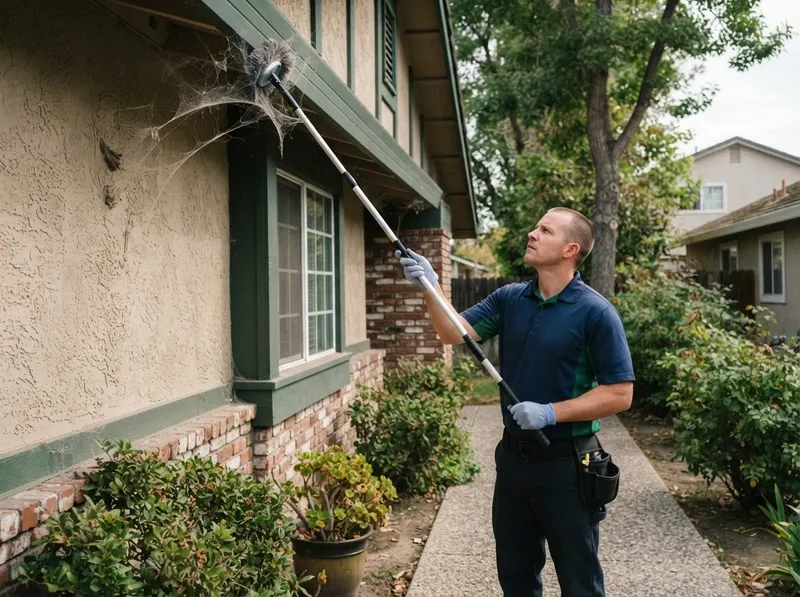
HarborStone Exterminators delivers systematic exterior de-webbing and targeted perimeter defense designed to halt arachnid intrusions around Stockton residences. Dense riparians and irrigation canals throughout Brookside, Lincoln Village West, and Weston Ranch create elevated mid-summer midge and aquatic insect blooms, supplying an abundant food source that pulls predatory spiders toward structural lighting, entryways, and under-eave recesses. Spiders gain access to living spaces through gaps around weep screeds, crawlspace vents, attic louvers, and unsealed door thresholds. Addressing an infestation requires physical destruction of harborages rather than superficial spraying alone, as adult spiders frequently avoid standard floor deposits by walking elevated on their tarsi.
Technicians utilize telescoping carbon fiber poles fitted with electrostatic brushes to sweep webs and egg sacs from roof overhangs, soffits, patio covers, and window casings. Sweeping eliminates current webbing while destroying silken egg sacs that harbor hundreds of emergent spiderlings. Following physical de-webbing, technicians apply microencapsulated pyrethroid or botanical suspensions along exterior foundation perimeters, window tracks, and plumbing penetrations in compliance with guidelines from the EPA Pesticide Program and the California Department of Pesticide Regulation. Microencapsulated formulations adhere directly to masonry, stucco, and wood surfaces, maintaining stability under Stockton's triple-digit summer temperatures without rapid ultraviolet breakdown. Structural exclusion guidance aligns with biological IPM recommendations from the UC Statewide IPM Program, focusing on sealing foundation penetrations and switching exterior fixtures from white incandescent lamps to yellow vapor bulbs to diminish nighttime prey attraction.
Decision guidance depends on property construction and proximity to water. Properties bordering the San Joaquin Delta waterways in Country Club or the man-made lakes of Spanos Park West experience rapid web accumulation along windward walls, necessitating combined physical removal with a continuous barrier treatment every 60 to 90 days. Conversely, inland properties along the Miracle Mile or Pacific corridor dealing with low-density yellow sac or cellar spiders often require a single thorough cleanout coupled with crawlspace vent screens meeting California Housing Code standards. Mechanical removal alone leaves chemical pheromone trails that prompt recolonization within weeks, while liquid barriers without web removal leave unsightly egg casings intact. Balancing both methods provides lasting clearance without locking homeowners into mandatory long-term service contracts. Operational handling follows safety directives outlined by Cal/OSHA, with pesticide disposal handled in accordance with the San Joaquin County Environmental Health Department and water protection criteria established by the California State Water Resources Control Board. Materials used are registered under the Association of American Pesticide Control Officials and cross-checked against ecological parameters cataloged by the U.S. Fish and Wildlife Service and the National Pest Management Association.
Every job gets a firm, written price after a free on-site visit.
For standards, safe disposal, and service guidance on PEST CONTROL SEVICE in Stockton, CA, useful references include U.S. EPA, ENERGY STAR, U.S. Dept. of Energy, Consumer.gov, U.S. Census Bureau, and Google Maps. General consumer and small-business resources are available from USA.gov, Better Business Bureau, FTC Consumer Advice, U.S. Small Business Administration, and Ready.gov.
Tell us about your spider and web removal service job in Stockton and we'll send a clear, written quote, usually the same day.
 HarborStone Exterminators