Termite activity in San Joaquin County stems primarily from two distinct biological threats: Reticulitermes hesperus (the western subterranean termite) and Incisitermes minor (the western drywood termite). In…
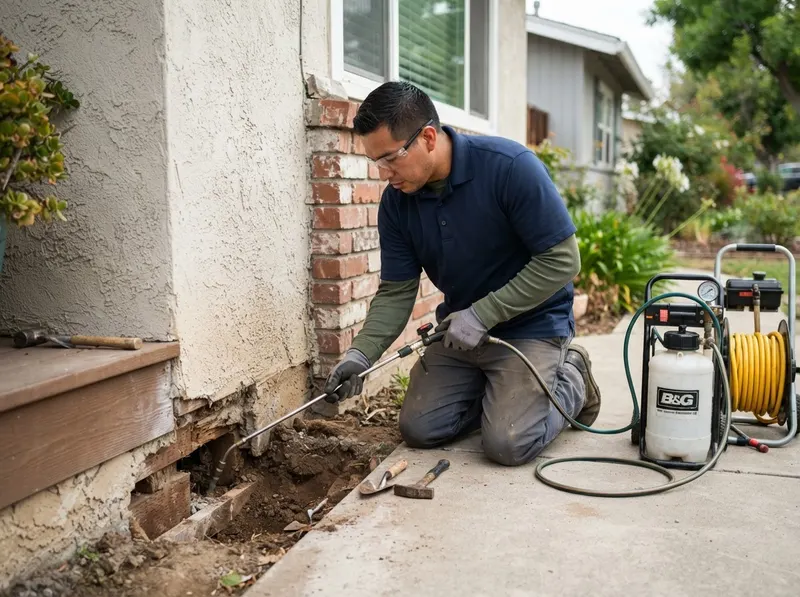
Termite activity in San Joaquin County stems primarily from two distinct biological threats: Reticulitermes hesperus (the western subterranean termite) and Incisitermes minor (the western drywood termite). In waterfront areas such as Brookside, Lincoln Village West, and Country Club, high water tables and irrigation moisture along the California Department of Water Resources Delta corridors create prime soil conditions for subterranean colonies. These insects build vertical shelter tubes over concrete stem walls to reach floor joists. Conversely, older architectural properties along the Miracle Mile and Pacific avenues frequently experience drywood termites entering through attic louvers, rafter tails, and eave gaps without requiring soil contact.
A precise physical examination determines whether localized treatments or full exterior soil barriers are required. In accordance with structural pest guidelines set by the California Structural Pest Control Board, diagnostic procedures involve sounding framing timbers with specialized mallets, probing wood members, and inspecting crawlspaces beneath pier-and-beam foundations. The University of California Statewide Integrated Pest Management Program notes that misidentifying dampwood termites near plumbing leaks as subterranean termites leads to unnecessary chemical soil applications; our team verifies the species to target moisture sources directly before treatment begins.
Treatment execution follows specific safety and environmental standards overseen by the California Department of Pesticide Regulation and the United States Environmental Protection Agency. Subterranean colonies require liquid termiticides placed into shallow perimeter trenches or injected beneath concrete slabs using rod tools to establish continuous treated zones. For isolated drywood infestations in Weston Ranch, Spanos Park West, or Spanos Park East, precision localized injections directly introduce non-repellent materials into gallery voids, avoiding whole-structure fumigation whenever framing damage remains concentrated in fewer than three accessible structural bays.
Property owners evaluating remediation options face clear technical trade-offs. Localized spot treatments minimize occupant disruption and carry lower upfront expense, yet they leave untreated structural timbers vulnerable if secondary undiscovered colonies reside elsewhere in the roofline. Non-repellent liquid soil barriers provide durable multi-year subterranean defense according to the USDA Agricultural Research Service, but require drilling patio slabs every 12 inches. Structural integrity checks adhere to building safety parameters outlined by the International Code Council and National Institute of Standards and Technology materials testing metrics, ensuring load-bearing sills remain structurally sound after infestation arrest. HarborStone Exterminators confirms all structural findings in writing prior to application, coordinating disposal of infested structural debris through facilities meeting standards from the California Department of Resources Recycling and Recovery and hazardous waste criteria under the California Department of Toxic Substances Control.
Every job gets a firm, written price after a free on-site visit.
For standards, safe disposal, and service guidance on PEST CONTROL SEVICE in Stockton, CA, useful references include U.S. EPA, ENERGY STAR, U.S. Dept. of Energy, Consumer.gov, U.S. Census Bureau, and Google Maps. General consumer and small-business resources are available from USA.gov, Better Business Bureau, FTC Consumer Advice, U.S. Small Business Administration, and Ready.gov.
Tell us about your termite inspection and treatment job in Stockton and we'll send a clear, written quote, usually the same day.
 HarborStone Exterminators